Life’s a journey. Enjoy the journey.
“Travel is a means of getting somewhere in order to do something. It is a necessity; it’s usually something that we do because we have to, not because we want to. Sometimes we wish we could click our fingers and instantly arrive at our destination. We tend not to like travelling because it’s uncomfortable, there’s not much space, not enough leg room, we spend our time stuck in traffic or on a broken down train… and we are completely powerless to do anything about it. The design principles of Shweeb aim to put you, the traveler, back in control of your own space, time and power.”- Shweeb

Shweeb is an innovative integration of two existing technologies – the monorail and the recumbent bicycle. The goal is simple, provide an urban transportation system that elevates the rider above the bustle of the city, providing a clean, fast commute.
Shweeb is an innovative form of alternative transportation that places people in plastic tubes so that they can cycle to their destination whilst hung upside down from a rail. It may sound crazy, uncomfortable and tiring, but Google believes that it could transform the way we get around cities — as such, they have invested $1.05 million.
Google’s interest came about thanks to their Project 10100, an initiative that seeks to find solutions that make the world a better place. Shweeb was named one of the top five as voted on by the public, claiming top honors in the “Drive innovation in public transport” category.
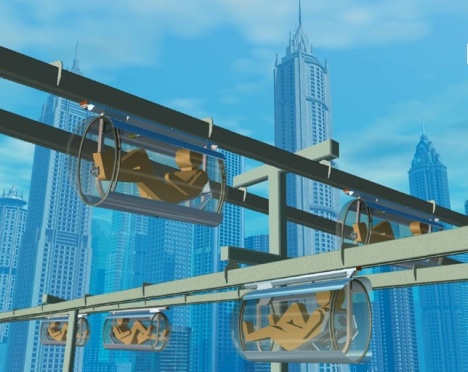
As the Shweeb system is ‘user-powered’ it immediately gets sustainability points, but the system has also been praised for its speed. The original prototype was built as a ride in an amusement park in New Zealand, where pod pedalers race each other on a side-by-side track for a fee of $35. There, users are suspended from the track in transparent pods and can ‘cycle’ around the landscape at speeds of up to 45km/h.
Shweeb cycles are equipped with seven gears and, according to the operators, the reclining position is necessary for both comfort and reducing drag. The system has been a big hit with tourists, and Google reckons it could find equal satisfaction from the commuting population of some of the world’s cities.
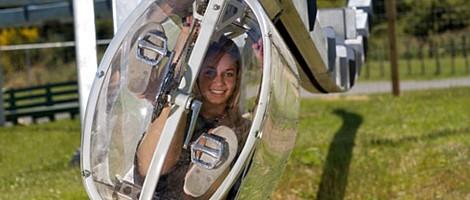
The idea was conceived by Melbourne cyclist Geoff Barnett while he was living in Tokyo. After six years researching his dream, he set up a test bed in Rotura and launched the system in 2007. Since then, more than 30,000 people have ridden the Shweeb system, and the current speed record is 55 seconds for a 600m ride.
Shweeb managing director Peter Cossey said the company would spend the $1.05 million on research and development to build a showcase transit system in the northern hemisphere: “The northern hemisphere became the natural choicefor us due to the sheer number of people that require transport and also the opportunity to achieve a higher global profile for the future growth of the company,” Mr Cossey said.