Madeleine VanHecke, Lisa Callahan & Brad Kolar
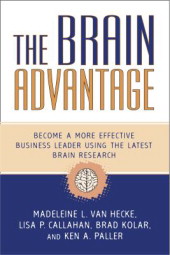
“The Brain Advantage: Become a More Effective Business Leader Using the Latest Brain Research“
What are some of the main themes of your book?
An overarching theme of the book is that the interactions between our brains and our conscious selves is opposite of what many people believe. More often than not, our brains are working behind the scenes to control what we pay attention to, what we remember, and how we interpret and process information. We work for it, it doesn’t work for us. Here are some examples:
1. The brain can fool us – but if we know its limitations, we can compensate for them.
For example, why did Yale students do worse than rats in predicting where food would be found in a maze? This happened because the students were sure that some meaningful pattern determined where the food would be. The brain searches for meaning and is quick to come up with plausible explanations of events, like why a rise or drop in sales occurred. The problem is that when events really are random, as the placement of the food in the maze was in the study with the Yale students, the brain can mislead us. As a result, a leader might change an advertising strategy, promote or demote a team leader – all because of a meaningless random fluctuation in results.
2. Understanding how the brain works can help us be more innovative.
Should you analyze problems in order to come up with innovative solutions, or should you go with your gut? What we now know about the brain is that the inspired insights that come to us depend on a wellspring of experience, knowledge, and exposure to ideas akin to our field but outside of it. We can help our brains build up the databases the brain needs to be able to arrive at great intuitive decisions.
3. We can harness the brain’s tendency to automate just about everything.
Our brain loves to automate whatever behavior we repeat. That’s why you don’t have to consciously think about how to ride a bike or tie your shoes. This makes us efficient. The downside is that routines that don’t serve us well also become automatic and we sometimes behave mindlessly. The good news is that we can train our brain to periodically step out of autopilot so that we have the benefits of efficiency without the downside of mindlessness.
4. We can keep our emotional brain circuits from hijacking our rational thinking.
The brain circuits that alert us to danger, trigger our fear, or give us a warm fuzzy feeling of safety evolved because they helped the human species survive. In today’s world, these circuits continue to react and guide us even when their reactions are no longer helpful. For example, if we glimpse a lion in foliage, the ancient brain instantaneously stops our movement. We freeze. This is a helpful response. But sometimes we freeze when there’s a sudden glitch in a project we are working on that makes us feel we’ll never be able to meet our deadline. Our anxiety can paralyze us. Research shows that when we “step back” from what is triggering an emotional reaction and shift our attention to problem solving we activate parts of the brain that engage in rational thought (the prefrontal cortex) and quieting circuits like the “worry circuit” that fuel our anxiety.
5. The brain is more social than we realized.
The brain reacts – often intensely – to the social aspects of situations. Being ignored, treated unfairly, or betrayed triggers strong reactions in us. So does falling in love, or witnessing someone we care about in pain. Brain research helps us understand why events that happened months earlier – such as a leader failing to recognize the contributions of a team to the success of a project – can cast such a long shadow on employee engagement and morale. Understanding the social aspects of the brain also makes us realize why the so-called “soft skills” are crucial to leadership success.
6. Our brains are not optimized for making sense of the world in which we live.
The last major physical change to our brains occurred about 40,000 years ago. The world was quite different then. There wasn’t data to analyze, co-workers to manage, or office politics to navigate. Instead, life was pretty simple. What happened one day was pretty likely to happen the next day. Our brain’s job was to keep us alive. As a result it adapted by over emphasizing certain things and under-emphasizing others in order to keep us focused on what mattered most (e.g., it’s probably important to pay attention to that snarling furry thing since one ate your brother last week than it is to spend a lot of time wondering about that little lizard that looks like all of the other little lizards that tends to run away from you). Unfortunately, in our current world, those adaptations sometimes get us in trouble. Latching on to and over-emphasizing familiar experiences can cause us to miss the subtleties of a rapidly changing world.
What prompted you to write the book?
For all three of us this project was the “perfect storm” of opportunity. First and foremost, it provided an opportunity for us to get together and do what we love – learn.
Second, the topic of the brain, was ironically, close to our hearts. Madeleine is a psychologist and professor of critical thinking. Lisa is in charge of improving the performance of the workforce of one of the world’s largest consulting companies. Brad works with executives to help them rethink the way they view their role, their work. Understanding the way the mind and brain work is central to the work we do. Finding a new way to think about this helps us help those people that we serve.
Third, we felt we had something new to say. Historically leadership and business books were pigeon-holed into being either about “hard skills” (e.g., strategy, analysis, decision making, and performance management) or “soft skills” (e.g., interpersonal relationships, emotional intelligence, and creativity/innovation). The research behind The Brain Advantage helped us see the connection between the two and make a case that they are not ends of a continuum but intertwined pieces of a puzzle.
Finally, we like each other! The project gave us an excuse to hang out and have some fun! (note: and the good news is that even after a year of debate, disagreement, and, at times, despair, we STILL like each other!)
What sparks your creativity?
It’s probably best that we address this one separately. One of the strengths of the book was the diverse perspectives and experiences we brought. Our interaction with one another sparked our collective creativity but each one of us is driven by something unique.
Lisa- “Engaging discussions with others—both those that share my interests and those with different interests that bring a different point of view. I’m also a big problem solver. When I see something that isn’t working, or when someone describes an issue they’re having, I immediately jump into problem solving mode. How can I help them? How can we get past the issues they’re having? Are there things that have never been tried before? Why not?”
Madeleine “1. Anomalies – because they make me curious; 2. Experiencing other people’s creative work – listening to a moving piece of music, art, dance, or drama inspires me. 3. Talking with and reading the ideas of other creative people, especially those who think or write about or work in areas that are close cousins to whatever I’m interested in at the moment. For example, right now I’m getting more and more interested in the power of questions so in addition to reading about the use of questions in business leadership, I’m also looking at the use of questions in negotiations, in teaching situations, in therapy, in sales, in coaching, and in conflict resolution. 4. Asking myself “what does that really mean?” For example, when I was writing my earlier book about why smart people do dumb things, I spend a lot of time thinking about what it means when we say that someone doesn’t “get it.”
Brad- “Constraints – I’m not one of those people who can sit down to a blank sheet of paper and do something creative. I need some tension or a problem to solve. To me, the greater the set of constraints, the greater the opportunities for creativity. Wonder – I also have a strong internal drive to understand how things work and more importantly, how they connect.”
What recently sparked your curiosity and how did you satisfy it?
Lisa- “I was recently reading a book called The American Frugal Housewife. It was written in the 1830s by a woman who was quite progressive for her time. The book contains what amounts to a stream of consciousness series of tips to save money in the home. One of my hobbies is working with stained glass. A tip in the book talked about being able to cut through a glass bottle cleanly by wrapping it in worsted thread soaked in turpentine, then setting the thread on fire. This immediately got me wondering whether it would really work, but I haven’t had a chance to try it. As soon as I started thinking about it though, I started asking myself other questions—what about kerosene? Other flammable liquids? How did they polish the edges in the 1830s? What did they use the bottles for? Would we use them for the same things today? What are all the things I could do with a cut-off bottle? It turned out to be a classic brainstorming problem.”
Madeleine- “A friend told me that he feels ignored when other people don’t ask him questions, yet when someone asks him what he called “too many questions,” he doesn’t like that either (an apparent anomaly). We had a long conversation about what makes the difference which led me to think about different types of questions and their effects. It also led me to think about the phrase “What a great question!” which brought to my mind examples of questions that I would call great questions – and ask myself – what makes them great? I am beginning to satisfy my curiosity about all this by reading – I went to amazon and googled “questions” to find various books, and in a couple of months I’m going to have a group I belong to discuss this topic, bringing samples of “great questions” with them. I’ll also probably have my antennae up so that whenever something related to this comes up in conversation, I’ll explore it with the other person.”
Brad- “I was recently reading three very different books and articles. On, was on the neuroscience behind how magic works. In the book, Neuroscience professors cross the country interviewing magicians to learn the “secrets” that they use to exploit the way our minds work. Some of these techniques date back centuries, long before functional MRI machines could “peek” inside the brain. The second was the memoirs of a Seal Team Six Sniper (Seal Team Six is the elite unite that drove the attack on Osama Bin Ladin). It struck me how much these guys know about the human mind. Their job might appear to be purely physical, but the reality is that to do what they do, you must be able to overcome many of the “hard-wired” behaviors toward which our brains naturally push us. The third article was by economist Paul Krugman. He talked about how between the 15th and 17th century, the map of Africa became less detailed to the point where rivers and villages disappeared. This happened despite advances in cartography and measurement. The problem was that as measurement techniques improved, the map makers discarded second and third hand data that wasn’t measureable and verifiable. As a result, instead of having a rough idea about reality, they acted as if nothing was there.”
“It got me thinking that too often we rely more on invented proxies for the world than we do on our own sense of that world. It changed the way I interact with my clients. I now encourage them and am much more curious about those things they can’t “measure” but somehow “know”.”
What’s one big thing you want people to take away from your book?
If we are going to be true to the theme of the book, we have to acknowledge that everyone will come to it with a different set of experiences, beliefs, and biases. As a result, each reader will draw a unique set of insights. Hopefully, each person will walk away with one or two tangible ideas that they can apply directly to their work.
Having said that, there are a couple of key take-aways that can guide anyone’s exploration of the book.
1) Stepping back from what the brain is so busily doing outside of our awareness and understanding how the brain works, we can direct its activities and so help ourselves make better decisions, have better relationships, and achieve our goals more effectively. And if we are in a leadership position, we can use our knowledge to help others do the same.
2) The lessons from the book create a paradox. If you buy-in to what the book says, you will begin to question everything about how you take in, interpret, remember, and act upon the information that is all around you. Yet, those very senses, memories, and experiences that you will question are needed to understand the book. So, be open. If you find parts of the book to be unbelievable or not applicable to your experience , it might be that you are falling victim to the very phenomena that your brain so cleverly is convincing you to question.
 Join us here at Catalyst Ranch, Tuesday, June 21st at 6pm when we welcome Madeline, Lisa and Brad for the next installment of our Match Books series. They will be sharing research and insights on how to become more effective decision-makers, communicators, and change-agents from their book “The Brain Advantage: Become a More Effective Business Leader Using the Latest Brain Research.” Cost is $15 or two children’s books to be donated to Open Books, check out Catalyst Ranch’s Happenings Page for all the info!